After the groundbreaking flights of NASA's Ingenuity helicopter on Mars, engineers at the Jet Propulsion Laboratory (JPL) are advancing rotor technology to enable larger, heavier rotorcraft capable of carrying scientific payloads across greater distances. This Q&A delves into the achievements of Ingenuity, the upcoming SkyFall mission, and the innovations required to fly in Mars' thin atmosphere. Jump to specific topics:
- What made Ingenuity's mission a breakthrough?
- How did Ingenuity exceed expectations?
- What is the SkyFall mission and when will it launch?
- What rotor technology advancements are needed for future Mars helicopters?
- How will new rotorcraft carry heavier payloads than Ingenuity?
- What role does the Perseverance rover play in these missions?
- What is the Space Reactor-1 and its connection to Mars rotorcraft?
What made Ingenuity's mission a breakthrough?
Ingenuity became the first airborne platform to explore another world, proving that controlled flight is possible in Mars' extremely low-density atmosphere—only about 1% as dense as Earth's. This dual-bladed helicopter demonstrated that rotorcraft can travel farther and reach inaccessible terrain like steep cliffs, craters, and rugged highlands that ground vehicles cannot navigate. The mission revolutionized planetary exploration by adding an aerial dimension, enabling scientists to scout vast areas quickly and access high-value science targets. Its success paved the way for future rotorcraft designs that can carry heavier instruments, such as spectrometers and sample-collection tools, expanding our ability to study Mars from the air.
How did Ingenuity exceed expectations?
Originally designed for just five flights over 30 days, Ingenuity far surpassed its goals, completing 72 flights before a crash-landing in January 2024. It operated for nearly three years, flying in diverse Martian weather conditions and at altitudes up to 24 meters. The helicopter provided high-resolution imagery and aerial surveys that supported the Perseverance rover's science objectives. Its longevity and reliability demonstrated that rotorcraft can endure the harsh Martian environment, including dust storms, extreme temperature swings, and low atmospheric pressure. This overachievement gave engineers confidence to design larger, more capable rotorcraft for upcoming missions.
What is the SkyFall mission and when will it launch?
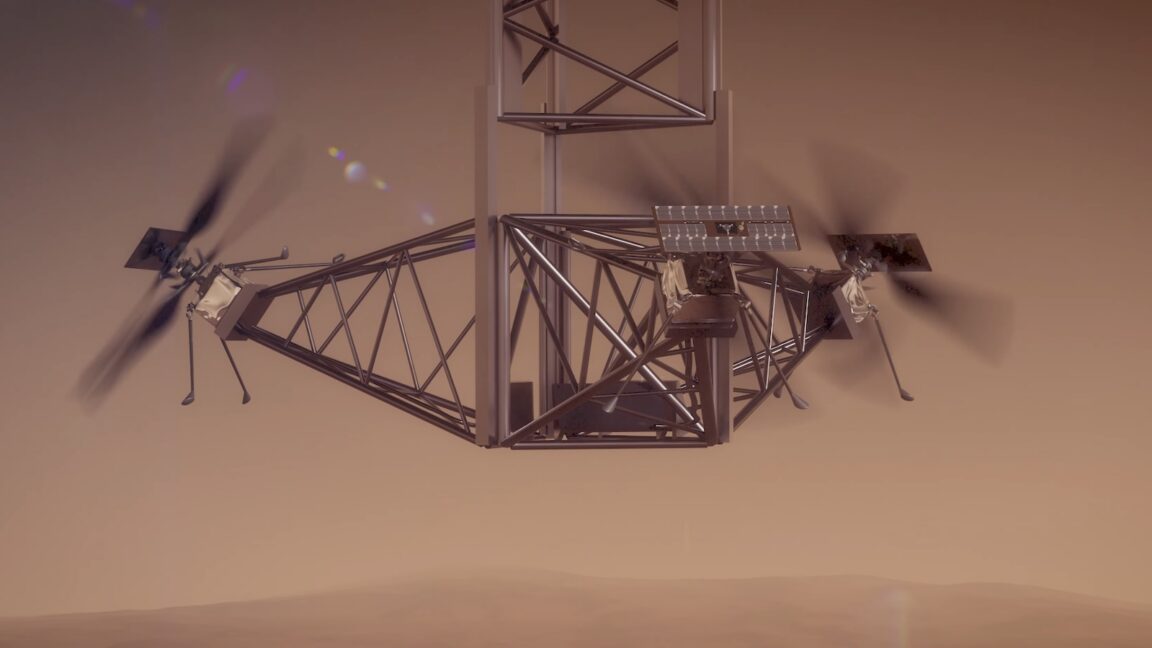
NASA's SkyFall mission plans to send three new helicopters to Mars, potentially launching as soon as late 2028. These rotorcraft will build on Ingenuity's design but will be scaled up to carry heavier scientific payloads over longer distances. SkyFall is part of a broader push to leverage aerial platforms for Mars exploration, with each helicopter capable of independent flight or coordinated operations. The mission will focus on regions of high astrobiological interest, such as ancient lake beds or volcanic terrains, where rotorcraft can collect samples and relay data back to Earth via orbiters.
What rotor technology advancements are needed for future Mars helicopters?
To fly in Mars' thin air while lifting heavier loads, engineers at JPL are developing larger rotor blades made from advanced lightweight composites. These blades must spin faster—up to 3,000 RPM compared to Ingenuity's 2,400 RPM—to generate enough lift. New high-torque motors and power-efficient batteries are also being tested to sustain longer flights. Additionally, autonomous navigation systems are being refined to handle more complex terrain without real-time human input, using onboard cameras and AI to avoid obstacles. The goal is to create a rotorcraft that can carry payloads of several kilograms, enabling onboard science instruments like hyperspectral imagers and drills.
How will new rotorcraft carry heavier payloads than Ingenuity?
The next-generation Martian helicopters will be physically larger—Ingenuity weighed only 1.8 kg, while future designs may exceed 10 kg. They will use multi-rotor configurations (e.g., coaxial or quadcopter layouts) to distribute lift and improve stability. Improved battery chemistry, such as lithium-sulfur cells, will provide higher energy density for extended flight times. The airframe will be constructed from lightweight but strong materials like carbon fiber and titanium to maximize payload fraction. These enhancements will allow the rotorcraft to carry instruments such as ground-penetrating radar, atmospheric sensors, and even small sample-collecting rovers, transforming how we conduct in-situ science on Mars.
What role does the Perseverance rover play in these missions?
The Perseverance rover served as the delivery platform and communications relay for Ingenuity, capturing its flights with cameras and transmitting data back to Earth. For future missions like SkyFall, Perseverance—or its successors—will continue to act as a base station, providing landing sites, power for charging, and high-bandwidth data links. The rover's own science instruments complement aerial surveys, allowing cross-referencing of data. Perseverance's successful partnership with Ingenuity provides a model for collaborative exploration, where rovers and rotorcraft work together to cover more ground and achieve shared objectives.
What is the Space Reactor-1 and its connection to Mars rotorcraft?
Space Reactor-1 (SR-1) is a nuclear-powered spacecraft selected as part of NASA technology demonstration initiatives announced by Administrator Jared Isaacman. SR-1 will provide the power and propulsion to transport the SkyFall helicopters to Mars. Using nuclear thermal or electric propulsion, SR-1 can shorten travel time and deliver larger payloads than chemical rockets. This enables the deployment of multiple heavy rotorcraft simultaneously. SR-1's high energy output also supports extended operations on the Martian surface, potentially recharging helicopter batteries or powering in-situ resource utilization experiments. The combination of nuclear space transport and advanced rotor technology marks a new era of ambitious Mars exploration.