Introduction
For over a decade, V8’s top-tier optimizing compiler, Turbofan, relied on an intermediate representation (IR) known as the Sea of Nodes (SoN). While SoN enabled groundbreaking optimizations, recent years have seen a deliberate migration toward a more traditional Control-Flow Graph (CFG) IR called Turboshaft. Today, Turboshaft powers the entire JavaScript backend of Turbofan and the full WebAssembly pipeline. Only two areas still retain Sea of Nodes: the builtin pipeline (gradually being replaced) and the frontend of the JavaScript pipeline (being supplanted by Maglev, another CFG-based IR). This article delves into the reasons behind this architectural pivot and what it means for V8’s performance future.
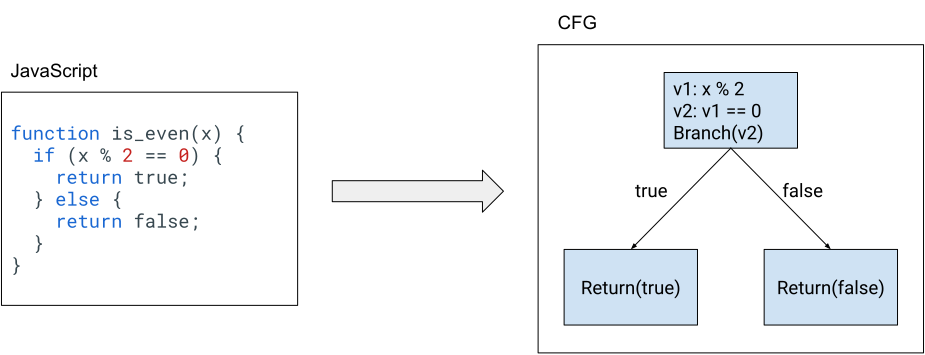
The Origins: Crankshaft and Its Limitations
Twelve years ago, in 2013, V8’s optimizing compiler was Crankshaft, a CFG-based system. Although Crankshaft delivered significant performance gains, its design quickly accumulated technical debt. Key issues included:
- Excessive hand-written assembly: Every new IR operator required manual assembly translation for all four supported architectures (x64, ia32, arm, arm64). This made development slow and error-prone.
- Struggles with asm.js: Optimizing asm.js—then a key pathway for high-performance JavaScript—proved difficult with Crankshaft’s rigid structure.
- No control flow in lowerings: Control flow was fixed at graph-building time. This prevented common compiler transformations, such as lowering a high-level
JSAdd(x, y)into a conditional sequence that checks operand types before choosing the correct addition operation. - Try-catch unsupported: Implementing exception handling was a multi-month effort that repeatedly failed, leaving a critical feature unimplemented.
- Performance cliffs and bailouts: Using certain features or hitting edge cases could cause a 100× performance drop, frustrating developers who sought predictable performance.
- Deoptimization loops: Crankshaft would re-optimize a function with the same speculative assumptions that had just caused a deoptimization, leading to an endless cycle of optimization and bailout.
Turbofan and the Sea of Nodes Solution
To overcome Crankshaft’s shortcomings, V8 introduced Turbofan with a radically different IR: the Sea of Nodes. SoN represented both data and control dependencies as a single graph, enabling flexible reordering and simplification passes. This design solved many of Crankshaft’s pain points:
- It allowed control flow to be introduced during lowering, enabling complex operations like type-specific
JSAddto be expanded into conditional logic. - It supported try-catch by modeling exceptions as edges in the graph.
- It reduced performance cliffs through more uniform optimization capabilities.
However, over time the very flexibility of SoN became a liability. The graph could grow massive, and optimization passes became intricate and hard to maintain. Debugging and profiling SoN graphs required specialized tools, and the learning curve for new compiler engineers was steep. Moreover, modern workloads—especially in WebAssembly and advanced JavaScript patterns—demanded simpler, more predictable compilation pipelines.
Why the Shift to Turboshaft?
The decision to move away from Sea of Nodes was driven by several factors:
- Maintainability: SoN’s complexity made it difficult to add new optimizations or fix bugs without upstream effects. A CFG-based IR like Turboshaft is closer to traditional compiler theory, making the codebase more accessible.
- Compilation speed: SoN required extensive graph rewriting, which could slow down compilation. Turboshaft’s linear CFG structure enables faster pass execution and simpler memory management.
- Incremental replacement: Rather than a full rewrite, the team could replace components piece by piece. Maglev, a CFG-based baseline compiler, now handles the JavaScript frontend that previously fed into Turbofan’s SoN graph.
- Better alignment with WebAssembly: WebAssembly’s structured control flow fits naturally into a CFG IR. Turboshaft’s pipeline for Wasm is already fully migrated, leading to more consistent performance and simpler code generation.
Turboshaft retains the key advantages of SoN—such as the ability to introduce control flow during lowering—but packages them in a more conventional framework that is easier to reason about and optimize.
Current State and Future Direction
As of today, the entire JavaScript backend of Turbofan runs on Turboshaft. The WebAssembly pipeline is fully Turboshaft-based. The only remaining SoN components are the builtin pipeline (which is being incrementally rewritten to use Turboshaft) and the JavaScript frontend (which is being replaced by Maglev). This transition has already yielded benefits: faster compile times, fewer deoptimizations, and a more maintainable codebase.
Looking ahead, the V8 team plans to complete the migration, phasing out Sea of Nodes entirely. This will unify the compiler infrastructure around a single, well-understood IR, simplifying future optimizations and reducing technical debt. Developers can expect more predictable performance and faster iteration cycles for JavaScript engines.
In summary, V8’s journey from Crankshaft to Turbofan’s Sea of Nodes, and now to Turboshaft, reflects an ongoing commitment to balancing innovation with pragmatism. The shift to a CFG-based IR is not a regression but an evolution—one that preserves the lessons learned from SoN while embracing a simpler, more sustainable architecture.