Introduction
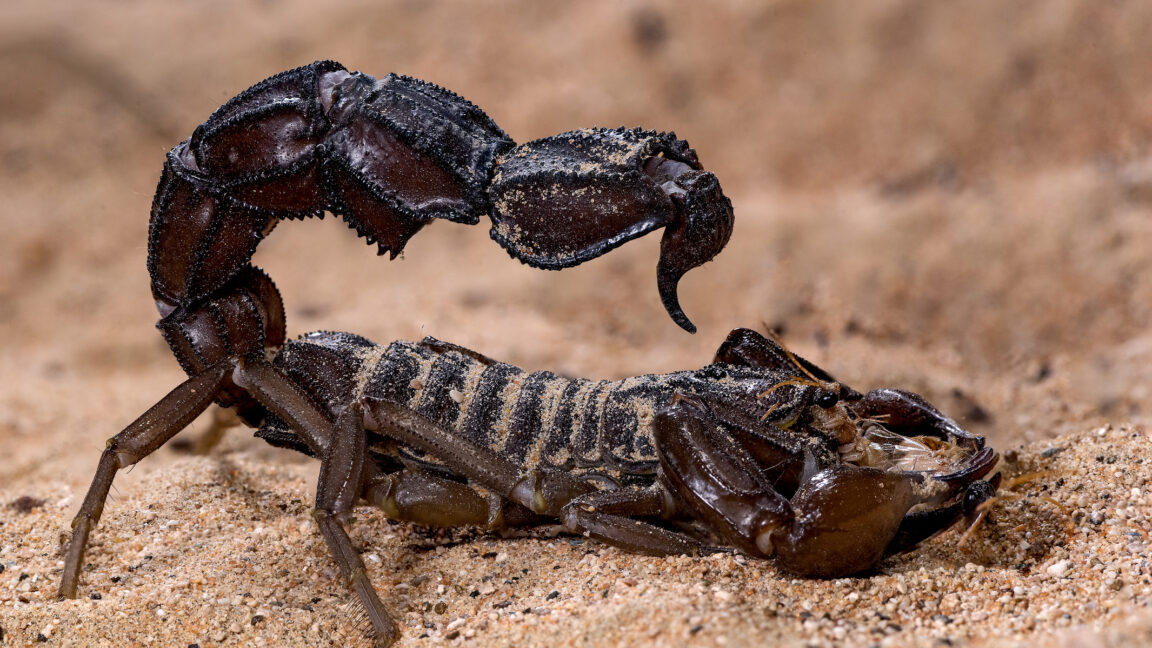
Scorpions have long fascinated and frightened humans with their dual pincers (called chelae or pedipalp appendages) and a venomous stinger (telson) at the end of their tail. These formidable appendages appear dangerous enough, but recent chemical analysis has revealed something even more remarkable: they are reinforced with metals such as zinc, manganese, and iron. This discovery raises a compelling question: did scorpions evolve this metal-infused armor on purpose, or is it just an accidental byproduct of their environment?
The Discovery of Metal-Reinforced Weapons
As explained by Sam Campbell, a biologist at the University of Queensland, Australia, the presence of metals in scorpion exoskeletons has been known since the 1990s. However, the reason behind this phenomenon remained unclear. Campbell led a team of researchers to investigate whether these metals are actively deposited or passively acquired from the soil and prey. Their findings, published in the Journal of The Royal Society Interface, provide strong evidence that scorpions intentionally build metal into their weaponry.
How Metals Make Scorpions Tougher
The metals—especially zinc—are concentrated in the cutting edges of the pincers and the tip of the stinger. This integration significantly enhances hardness and wear resistance, allowing scorpions to repeatedly use these tools without dulling. In essence, the metals act as a natural coating that extends the life of their primary offensive and defensive structures. This is similar to how human tools are hardened with metal alloys, but scorpions do it at a biological level, molecule by molecule.
Intentional Evolution or Environmental Absorption?
One of the key challenges in studying biological metal use is distinguishing between active adaptation and environmental contamination. Many arthropods absorb metals from their habitat—for example, spiders accumulate zinc from their diet. But Campbell's team performed a detailed analysis across multiple scorpion species from different geographic regions, and the results were consistent: the metals were not randomly distributed but precisely localized to high-stress areas. This pattern strongly suggests evolutionary selection, not accidental uptake.
Comparing Species and Habitats
To further confirm their hypothesis, the researchers examined several scorpion species with varying lifestyles and habitats. They used electron microscopy and X-ray spectroscopy to map the elemental composition of the exoskeleton. Across all examined species, the metal-rich zones corresponded exactly to the points of mechanical contact—the claw tips and the stinger point. This uniformity across diverse environments indicates a genetic blueprint rather than a passive absorption process.
Research Methodology and Key Findings
The study employed advanced imaging techniques to visualize the distribution of metals within the chitinous exoskeleton. They discovered that zinc is particularly abundant in the outermost layer of the cutting edges, forming a sort of biological ceramic. Manganese and iron appear in lower concentrations but contribute to overall toughness. The researchers also conducted mechanical tests, confirming that these metal-enriched regions are significantly harder than the surrounding cuticle.
Implications for Biomimicry
Understanding how scorpions incorporate metals into organic materials could inspire new technologies. Engineers and materials scientists are already exploring ways to create self-repairing structures or super-hard coatings based on biological models. The scorpion's method of integrating metals into chitin without disrupting the underlying biological processes offers a roadmap for producing lightweight, durable composites. Moreover, the fact that scorpions have been perfecting this technique for hundreds of millions of years highlights the power of evolution in engineering.
Conclusions and Future Directions
The research by Campbell and his team closes a longstanding question: scorpions do not merely collect metals from their surroundings—they deliberately incorporate them into their weapon systems. This intentional biological enhancement gives them a formidable edge in their harsh, competitive environments. As future studies probe the genetic mechanisms behind metal transport and deposition, we may unlock even more secrets of nature's built-in armor.
In the larger picture, this discovery reminds us that even the most well-known creatures still hold surprises. The next time you see a scorpion, know that its pincers and stinger are not just natural but are nature's version of a reinforced weapon—developed through evolution, refined over time, and now understood a little better thanks to modern science.
Frequently Asked Questions
- Why do scorpions need metal-reinforced weapons? The metals enhance hardness and resistance to wear, allowing scorpions to capture prey and defend themselves more effectively.
- Is this unique to scorpions? No, some other arthropods also use metals, but scorpions show a particularly precise and consistent distribution across species.
- Could this research lead to new materials? Yes, biomimicry researchers could learn from scorpions to create strong, lightweight composites for tools or armor.
Related: Back to Introduction | The Discovery of Metal-Reinforced Weapons